
Have you ever dreamt of negotiating a business deal in Shanghai, watching Anime without subtitles in Tokyo, or chatting fluently with locals in Seoul?
For many, learning an East Asian language feels like climbing a mountain. Most textbooks available globally are designed for English speakers, often making the pronunciation and grammar feel alien and difficult.
But here is a secret: As an Indian learner, you already possess a massive linguistic advantage—you just don’t know it yet.
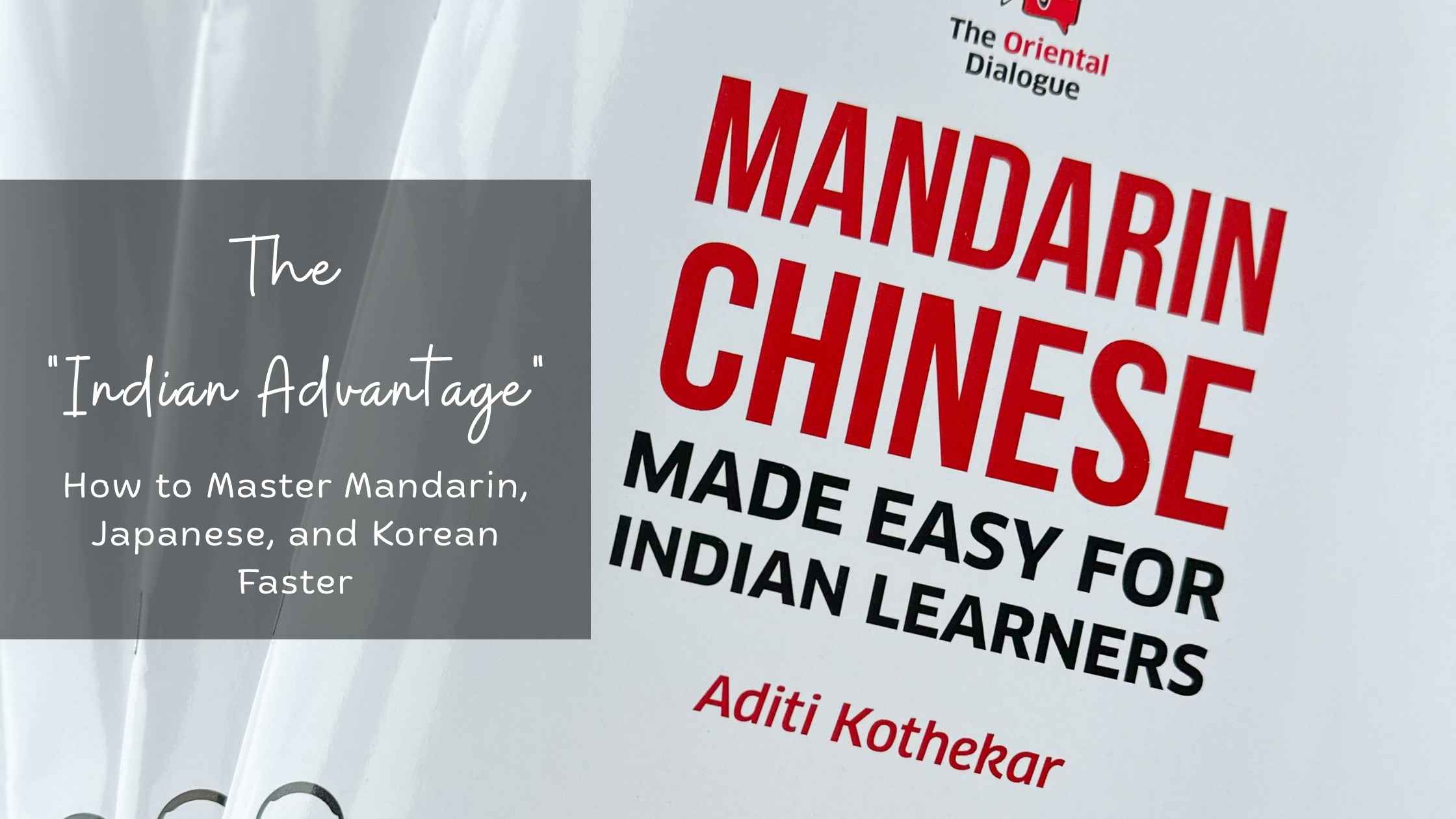
At The Oriental Dialogue, we believe learning should be a colourful, cheerful discovery, not a struggle. That is why we have created our own line of textbooks for Mandarin Chinese, Japanese, and Korean, specifically tailored for the Indian mind. We turn your cultural and linguistic background into your superpower.
1. Korean: Logic That Feels Like Home
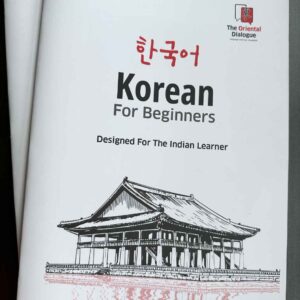 The Korean culture (Hallyu) has swept across India, but the true fluency advantage lies in the language’s structure. Our “Korean for Beginners” textbook leverages deep linguistic similarities to fast-track your learning, regardless of your prior background.
The TOD Advantage for Korean Learners:
-
Grammar Twins (Subject-Object-Verb): The most significant advantage is syntax. In English, you say “I eat an apple” (Subject-Verb-Object). But in Korean, just like in Hindi or Marathi, you say “I apple eat” (Subject-Object-Verb). This structural similarity significantly reduces the cognitive load for Indian learners, who are already wired for this sentence order, allowing them to pick up sentence formation much faster than a native English speaker would.
-
Phonetic and Script Comparison using Devanagari: We introduce the Korean alphabet (Hangul) using direct phonetic comparisons in Devanagari script. For instance, we show how the Marathi word for ‘mother’ (Aai) sounds similar to the Korean word for ‘child’ (Ai). This makes pronunciation rules highly accessible, simplifying vowels and consonants.
-
Contextual Communication: The textbook explains that Korean relies heavily on context, often omitting personal pronouns. This concept is directly paralleled by noting that conversational Hindi/Marathi often excludes pronouns like your (Aapka or आपका) when the context is clear, making the logic stick easily.
Key foundational topics covered include the two number systems (Sino-Korean and Native Korean), essential grammar like “To Be” (이다) and “To Have/Exist” (있다/없다), and practical conversational cues (like the differing forms of “goodbye”—annyeonghi gyeseyo vs. annyeonghi gaseyo).
2. Mandarin Chinese: Made for Desi Tongues
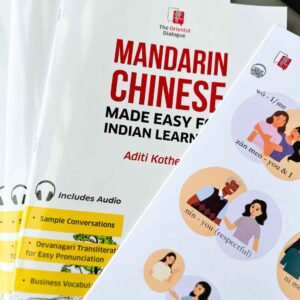 Mandarin is often cited as the hardest language due to its tones. However, our guide, “Mandarin Chinese Made Easy for Indian Learners,” proves that for you, it is quite logical.
Your Perfect Start for Mandarin:
-
The Devanagari Hack for Tones: We don’t just use English letters (Pinyin) to teach Chinese sounds. We use the phonetic clarity of the Devanagari script. Since Indian scripts are phonetic, you will pronounce the complex Five Tones (high-pitched, rising, down-up, falling, and neutral) exactly as they are meant to be spoken, giving you a massive edge over Western learners.
-
Words You Already Know: You speak more Chinese than you think! We start with terms already common in India, like Hakka, Chow-mein (meaning stir-fried noodles), Szechuan, Fengshui (meaning Wind and Water), and YinYang.
-
Practical & Business-Focused Skills: The content emphasizes practicality, covering essential Business Vocabulary like ‘meeting,’ ‘exhibition,’ ‘product,’ ‘price,’ and modern Chinese payment methods (such as WeChat and AliPay).
-
Addressing Dietary Needs: Recognizing common requirements, the book includes crucial language for dining out, with phrases like Wǒ shì sùshízhě (I am a vegetarian) and vocabulary for specific vegetarian dishes in China, making travel stress-free.
The course also covers fundamentals like the history of Chinese characters, tracing their origins back to pictograms, and mastering the proper use of the verb ‘To Have’ (yǒu). Audio resources are accessible via QR codes for enhanced learning.
3. Japanese: Beyond Just Language
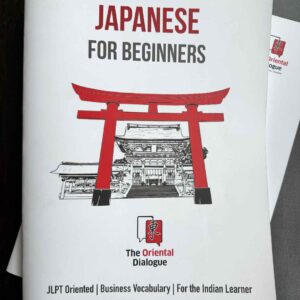 Stepping into Japanese culture is a rewarding experience, but it requires more than just vocabulary—it requires the correct social and professional “know-how.” Our “JAPANESE FOR BEGINNERS” textbook is your trusted companion, blending strict language skills with deep cultural immersion.
Why This Textbook is a Must-Have:
-
JLPT & Career Oriented: This resource is structured to help you clear the JLPT (Japanese Language Proficiency Test) levels (starting with mastering the Hiragana script and the full writing system) and integrates key Business Vocabulary for professional proficiency.
-
Immersive Cultural Insights: Language mastery is incomplete without cultural understanding. We teach you the cultural nuances and social etiquette, such as the meaning behind different bowing angles (Ojigi), the proper way to say goodbye, and even help you define your Ikigai (reason for being). This preparation is crucial for developing trust and successful business relationships in Japan.
-
Comprehensive and Effective Learning: The curriculum guides you through fundamental aspects, including essential grammar structures, practical vocabulary, and elements like telling time, navigating numbers, counting people, and age. The publishers, a language and cultural centre specializing in Japanese, ensure the process is smooth and enjoyable. Ganbatte kudasai! (Good luck!)
Start Your Journey Today
Learning a new language opens doors to culture, friendship, and massive global business opportunities. Don’t use a generic textbook that treats you like a stranger. Use a resource that recognizes your existing linguistic advantage.
Pick up a specialized textbook from The Oriental Dialogue today. Let us help you turn that “foreign” language into a familiar friend.